
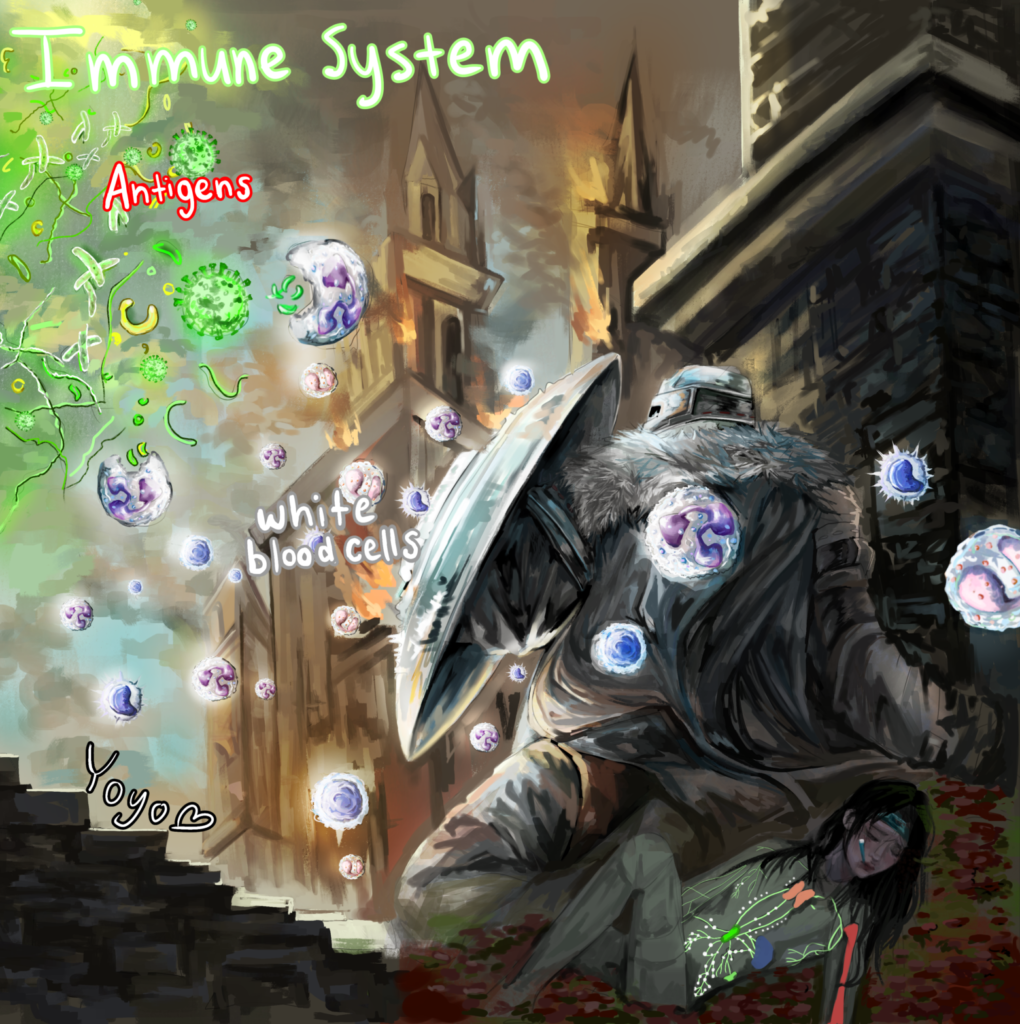
The immune system is the body’s defence network. Its role is to identify and eliminate harmful invaders such as bacteria, viruses, and parasites. Rather than functioning as a single organ, the immune system is composed of specialized cells, tissues, and organs that work together in a coordinated manner.
The immune system begins protecting the body before pathogens even enter the body. A pathogen is anything that can cause disease or illness. This can include viruses, fungi, or parasites. Physical barriers prevent most microbes from getting inside. The skin acts as a tough outer shield, while mucous membranes lining the nose, mouth, lungs, and digestive tract trap particles. Tiny hairs called cilia move mucus and trapped pathogens out of the respiratory system. Chemical defences also play a role. Stomach acid kills many microorganisms that are swallowed, and enzymes in saliva and tears break down bacterial cell walls. These defences are non-specific, meaning they act against any potential threat without actually identifying it.
If a pathogen gets past the first barriers, the innate immune system responds quickly. This response is still non-specific but involves immune cells that actively attack invaders. White blood cells, such as macrophages and neutrophils, patrol the body. When they counter a pathogen, they engulf and destroy it through a process called phagocytosis. This is a process where a cell engulfs large particles by extending its membrane to form a little pocket to eat. Inflammation is another key response. Infected or damaged cells release chemicals that increase blood flow to the area, causing redness, heat, swelling, and pain. These changes to the body help immune cells reach the infection site quickly. Among these innate responses is fever. Raising body temperature can slow the growth of pathogens and improve immune cell efficiency. Most bacteria and viruses that infect the human body thrive best at the temperature of 37°C. A higher temperature makes the body less habitable.
After the second phase, the adaptive immune system provides a highly specific defence. Unlike innate immunity, it recognizes unique markers called antigens on pathogens. Lymphocytes (white blood cells) are the main cells involved. There are two major types: B cells, which produce antibodies that bind to specific antigens and mark pathogens for destruction, and T cells that coordinate the immune response or directly kill infected cells. Helper T cells activate other immune cells, while cytotoxic T cells destroy cells that have been infected by viruses or turned cancerous (rapidly multiplying). This line of defence takes longer to activate than the innate response, but is much more precise. One takes a few hours, while the other takes days or weeks.
One of the most important features of the adaptive immune system is memory. After an infection has been cleared, some B and T cells remain in the body as memory cells. If the same pathogen enters again, the immune system responds faster and more effectively, often stopping the illness before the symptoms appear. This principle is the basis of vaccination. Vaccines expose the immune system to harmless forms or pieces of a pathogen, allowing memory cells to form without causing disease.
In conclusion, the immune system is an indispensable defence network, operating through a seamless interplay of layered protection. It prevents entry, responds rapidly to threats, and mounts targeted attacks with long-term memory. By continuously adapting to new challenges, it plays a critical role in maintaining health and survival in the human body.
References
Chaplin, D. D. (2010). Overview of the Immune Response. Journal of Allergy and Clinical Immunology, 125(2), S3–S23. https://doi.org/10.1016/j.jaci.2009.12.980.
Dagenais, A., Villalba-Guerrero, C., & Olivier, M. (2023). Trained immunity: A “new” weapon in the fight against infectious diseases. Frontiers in Immunology, 14. https://doi.org/10.3389/fimmu.2023.1147476.
Johns Hopkins Medicine. (2024, February 14). Vaccines. Www.hopkinsmedicine.org. https://www.hopkinsmedicine.org/health/treatment-tests-and-therapies/vaccines.
Justiz, A. A., & Jan, A. (2024, July 27). Physiology, Immune Response. Nih.gov; StatPearls Publishing. https://www.ncbi.nlm.nih.gov/books/NBK539801/.
NCBI. (2023, June 6). How does the Immune System work? National Library of Medicine; Institute for Quality and Efficiency in Health Care (IQWiG). https://www.ncbi.nlm.nih.gov/books/NBK279364/.
Science Olympiad. Immune System. https://www.soinc.org/sites/default/files/uploaded_files/2018_IMMUNE_SYSTEM_HANDOUT.pdf.
Silva, M. T., & Correia-Neves, M. (2012). Neutrophils and Macrophages: the Main Partners of Phagocyte Cell Systems. Frontiers in Immunology, 3. https://doi.org/10.3389/fimmu.2012.00174.
Yamaguchi, S. (2025). Immune-Based Botnet Defense System: Multi-Layered Defense and Immune Memory. Information, 16(8), 680. https://doi.org/10.3390/info16080680.